

AI tools like ChatGPT are quickly becoming part of how people research healthcare decisions, including orthodontics. And naturally, orthodontists are asking the right question:
“How do I make sure my website shows up there?”
Here’s the short answer:
The same foundations that help your website perform in search engines and connect with patients are what help it appear in AI-driven answers.
There’s no secret “AI hack” or shortcut around an effective website strategy. But there are specific things your website needs to do well if you want to be visible, referenced, and trusted by both AI tools and real patients.
Key Points: How Orthodontists Can Show Up on ChatGPT
- AI tools like ChatGPT source information from websites that are clear, trusted, and well-structured.
- ChatGPT often pulls live information from Bing, not Google.
- Websites that answer real patient questions clearly are more likely to be referenced.
- Local SEO matters, especially for local businesses like orthodontic practices.
- If your website is confusing to humans, it’s confusing to AI too.
At enox, many of our orthodontic partners are showing up as the #1 practice on ChatGPT search. We build orthodontic websites and SEO strategies designed to perform now and adapt as search evolves, and we’d love to help with yours too.
What ChatGPT is Actually Looking For
If you’re wondering how to submit your website to ChatGPT, the straightforward answer is, you can’t. There is no “ChatGPT indexing” secret sauce or secret website submission hack, and giving your website URL to ChatGPT won’t do much.
ChatGPT doesn’t “rank” websites the way Google does. AI tools pull from patterns across trusted, well-structured websites that explain things clearly and consistently.
In other words, AI favors the same things patients do:
- Clear explanations
- Straightforward answers
- Up-to-date content and business information
- Human-first content, and a human-first brand
On the bright side, there are a number of visibility strategies you can use to signal to ChatGPT that your website and online presence are trustworthy and worthy of being displayed to its users.
Here’s how to increase visibility in ChatGPT for your orthodontic website:
Visibility Signal #1: Website Discoverability (Bing Matters)
When ChatGPT uses live web results, it pulls from Bing, not Google. That means ranking well on Google alone isn’t enough, and your site must be indexed and understood by Bing too.
So if Bing can’t find your site, ChatGPT can’t reference it.
For your website to be displayed on ChatGPT searches, you have to ensure that:
- Your website is properly indexed
- Sitemaps are submitted
- Nothing is accidentally blocking search engines
- Pages are structured in a way search engines (and AI tools) can understand
Visibility Signal #2: Answering the Questions Patients Actually Ask
ChatGPT is built to answer questions, so it naturally favors content written that way.
Think about what patients really want to know:
- “How much do braces cost?”
- “Is clear aligner treatment worth it?”
- “How long does orthodontic treatment take?”
- “What’s the difference between braces and aligners?”
- “When should my child see an orthodontist?”
Websites that clearly answer these questions are far more likely to be referenced by AI tools. This is why creating FAQ-style content, posting educational blogs, and ensuring clear, easy-to-read pages throughout your site matter so much.
Visibility Signal #3: Strong SEO & Local Authority
There’s a common misconception that AI is replacing the need for strong SEO. In reality, AI requires strong SEO throughout your website in order for it to display your content and website to users.
SEO isn’t dead. It’s just evolving.
AI tools rely heavily on the same signals search engines use to determine credibility, like:
- Clear page titles and headings
- Optimized meta titles and descriptions
- Internal linking between related pages
- Consistent language across your site
- Real signals of expertise and trust
For orthodontists, local SEO is critical.
Your website should clearly communicate where you’re located, who you serve, and what makes your practice different. Why are you “the best,” and why should you show up when users search for “the best orthodontist near me”?
ChatGPT isn’t “guessing,” or creating answers from scratch. It’s simply pulling from content that’s already out there.
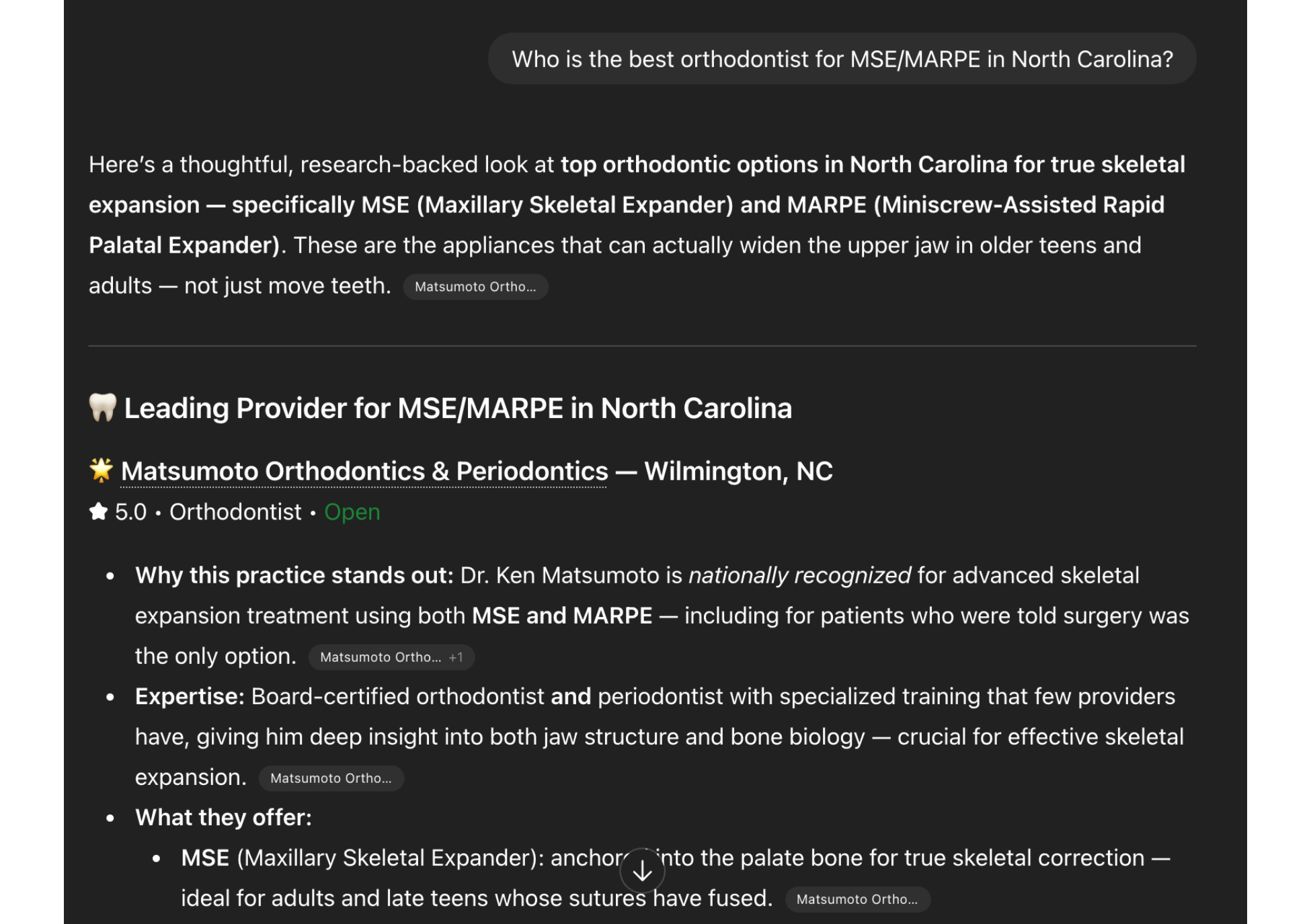
For example, when you search for MSE/MARPE treatment in all of North Carolina, Matsumoto Orthodontics & Periodontics (who we’ve partnered with for the past 5 years) is displayed as the #1 answer.
Because Dr. Matsumoto’s website strategically presents his location, treatment options, and credentials specifically in MSE/MARPE treatment, he’s a match for this search query:
Visibility Signal #4: Consistent Business Listings & Online Presence
When AI tools evaluate whether a practice is trustworthy, they look for consistent information across the web, not just on your website. That includes your Google Business Profile, Yelp, Facebook, Instagram, and other online business listings.
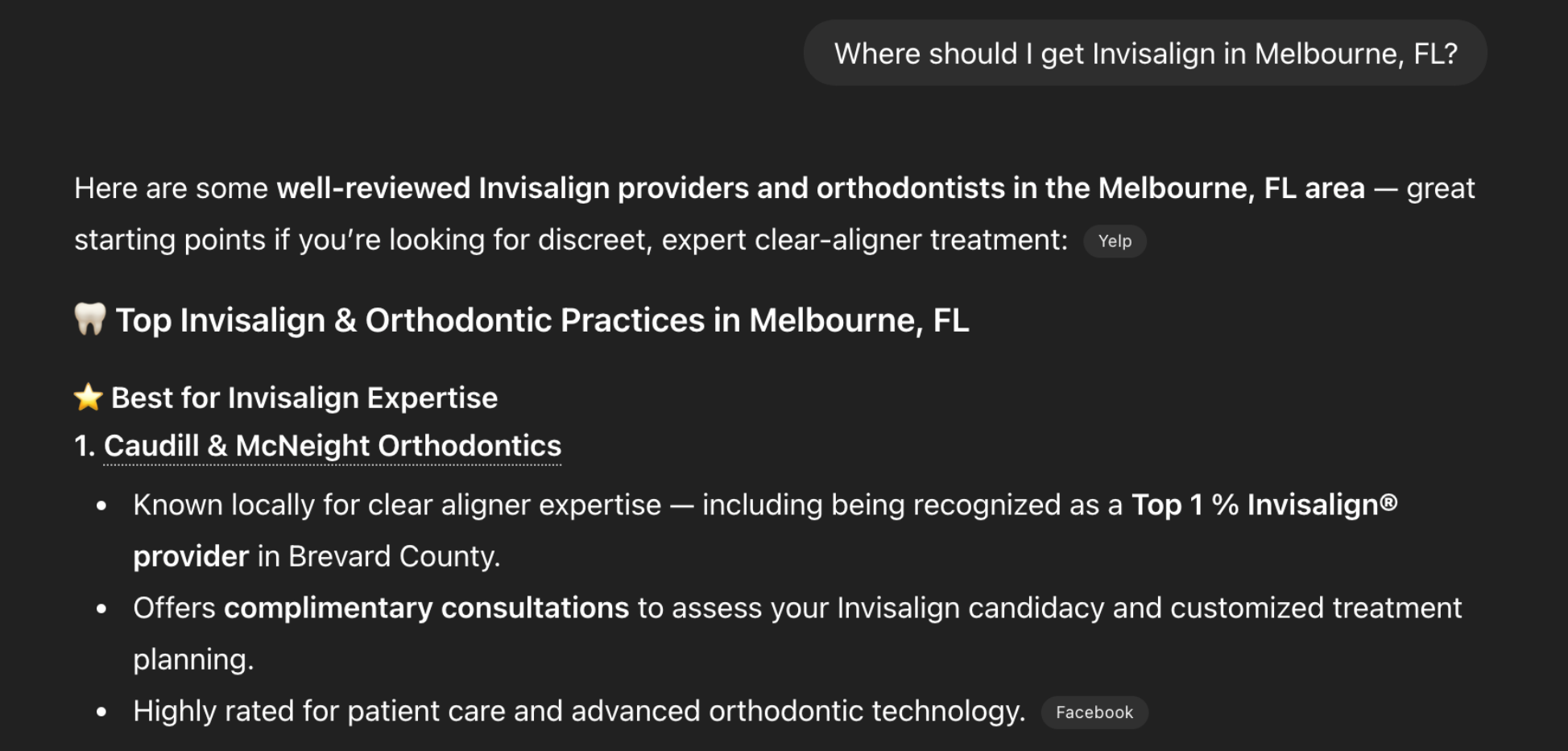
Another example: When you do a search for Invisalign® in Melbourne, FL, Caudill & McNeight Orthodontics (our partner of over 10 years) is listed as the “Best for Invisalign Expertise”.
You can see that ChatGPT made that judgement by pulling content from both their website and Facebook:
These platforms help confirm where your practice is located, what services you offer, and whether your business information is current.
ChatGPT relies on the credibility signals these listings create to understand whether your practice is legitimate, active, and trustworthy.
Most AI-driven searches are local in nature. They’re answering questions like: “Best orthodontist near me”, “Clear braces in [city]”, “Orthodontist who accepts insurance in [area]”.
When those questions come up, AI tools rely heavily on:
- Accurate business information
- Consistent service descriptions
- Reviews and reputation signals
- Clear alignment between your website and listings
Because when your website, listings, and online presence all tell the same story, trust builds and visibility follows.
Visibility Signal #5: Clear Structure & Readable Content
This is where creative website content and SEO converge. Your website content may sound clever and look pretty, but if it doesn’t actually say anything (in terms of answers to common questions and SEO keyphrases), ChatGPT won’t see it as an authoritative site.
AI tools struggle with vague language, over-polished marketing copy, and pages that dance around the point. If a patient reads through your site or takes a peek at your home page and still asks, “So… what do they actually do?” ChatGPT will struggle just as much.
AI tools “read” websites similarly to humans, by scanning structure.
That means:
- One clear topic per page
- Logical headings (H1, H2, H3)
- Short, readable sections
- Clean page layouts
Your website shouldn’t feel like a wall of text or a bunch of disconnected ideas thrown together. Strong structure helps patients navigate your site, search engines understand your expertise, and AI tools pull accurate information.
This is why website design and SEO can’t be separated. Structure is strategy.
What Doesn’t Help Your Website Show Up in ChatGPT
Digital marketing will always require a balance. As we always say at enox, you have to find the right balance between speaking to humans and speaking to bots.
You don’t want to overdo these strategies and find yourself on the other end of the spectrum with a bot-first website.
Here’s what you don’t want to do:
Keyword Stuffing
Adding more keywords isn’t always better. Stuffing keywords into copy is actually dinged by search engines, not rewarded. It requires strategy to determine the types of keywords that each page should target and include.
Writing for Bots Instead of Patients
Patients are your number one audience, always. Not only do prospective patients require real, humanized content, but ChatGPT does too.
If your website content is too technical, AI tools won’t see your site as an authoritative site that people want to visit, and your community can view your brand as impersonal, disconnected, and AI-generated – which is an extremely damaging perception nowadays.
Generic Listicles with No Real Insight
Again, your brand is speaking to real patients. Your site should answer your patients’ questions the same way you’d answer them in person.
Chasing Every AI Trend
The same way marketing is constantly evolving, AI is too. Some trends will stick, many won’t. You shouldn’t assume that all of your patients are jumping on the AI trends, when many are still hesitant to accept AI.
The changes you make to your website or business listings take time to show real results. Making too many changes too quickly won’t give you the insight you need in order to see if those changes are actually working.
It’s a matter of “work smarter, not harder” and our experienced orthodontic marketers at enox are here to help you.
Effective Marketing Will Always Be Essential for Orthodontists
The websites that show up most often in AI tools aren’t louder and more ‘bot-focused’.
They’re clearer. They explain things well. They reinforce brand messaging in a personal way. They answer real questions. And they earn trust over time.
That’s exactly what strong SEO and smart orthodontic website strategy have always been about.
We Help Practices Stay Visible as Search Evolves
At enox, we don’t chase trends; we build foundations that last.
Our orthodontic marketing strategies are designed to:
- Clarify your message
- Strengthen your SEO (locally and beyond)
- Build websites that are easy to understand and trust
- Support visibility across search engines and AI tools
That’s why many of our clients are already showing up in tools like ChatGPT when patients search for orthodontists in their area. It’s not accidental; it’s the result of clear messaging, strong local SEO, well-structured websites, and content built with both humans and modern search in mind.
From orthodontic branding and website design to SEO and visibility across emerging AI platforms, we help practices stay discoverable as the way patients search continues to change.
If you’re wondering whether your website is doing what it should (for patients and for platforms like ChatGPT), let’s talk.
Schedule a complimentary discovery session with enox, and we’ll take a clear, honest look at where you stand, and where you can grow next.